
By the Dropship Stair team. Last reviewed: November 2026.
Key takeaways
- How to increase average order value on Shopify comes down to one idea: help each buyer add one more useful item or pick a better option before they pay.
- Free shipping thresholds, bundles, and post-purchase upsells are the three highest return tactics for most stores, and each one is easy to test.
- Every tactic must protect margin: an upsell that costs more to fulfill than it earns is a loss, not a win.
- Measure average order value weekly and test one change at a time, so you know which tactic actually moved the number.
How to increase average order value on Shopify means getting each buyer to add one more item or choose a better option. Bundles, free shipping thresholds, and post-purchase upsells raise order value without new traffic. Start with the tactic that fits your best sellers.
What is average order value and why does it matter?
Average order value is the total revenue from orders divided by the number of orders, and it tells you how much each buyer spends in one visit. A store with 100 orders and $3,200 in revenue has an average order value of $32. Raise that number to $40 and the same 100 orders earn $4,000, with no extra ad spend and no new visitors needed.
That is why average order value matters more than most sellers think. Traffic and conversion get the attention, but order value is the lever that turns the same traffic into more revenue. A store that raises order value can also afford to spend more to win each customer, which makes its ads work harder than a competitor with the same traffic and a lower order value.
Find your number in Shopify Analytics under the sales reports, and note it before you change anything. You need a baseline, or you will not know whether a new tactic helped. Track it weekly, not daily, because daily numbers jump around with a few big orders. Our guide to Shopify analytics for beginners shows where to find the report and which numbers to watch with it.
How do free shipping thresholds raise order value?
A free shipping threshold tells the buyer that shipping is free once the cart passes a set amount, and many buyers will add one more item to reach it. The trick is setting the threshold just above your current average order value. If your average order is $32, a threshold of $40 or $45 pulls a good share of buyers upward. Set it at $75 and most buyers will ignore it; set it at $30 and you give away free shipping on orders that would have paid for it.
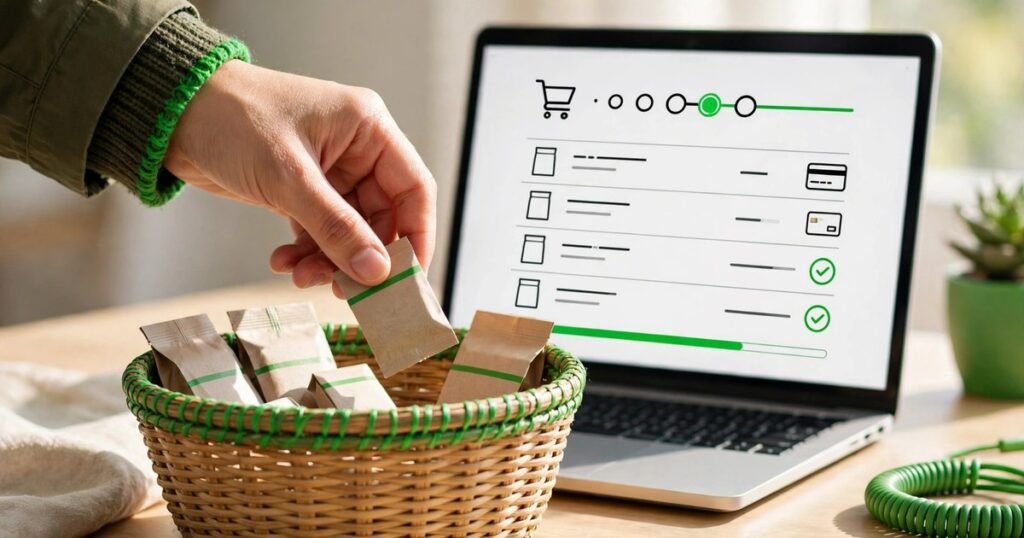
Show the gap clearly. A progress bar on the cart page that says free shipping is $8 away turns a vague offer into a concrete target, and it works best when the next item a buyer might add costs close to that gap. Pair the threshold with a small collection of low priced add-ons near the cart, so the extra item is one click away instead of a new search.
Check the margin before you set the threshold. Free shipping costs you the shipping fee on every order above the line, so the extra items buyers add must cover it. If shipping costs $7 and the average added item earns $5 of margin, the threshold loses money. Raise the threshold or pick add-ons with better margins until the math works.
How do bundles and volume discounts work?
A bundle groups two or three related products at a price slightly below buying them separately, and it works because the buyer sees a deal and the store sells more units in one order. A skincare store can bundle a cleanser with a moisturizer, a pet store can bundle a toy with treats, and a fitness store can bundle a band with a guide. The bundle must feel like a real set, not a random pile of products.
Volume discounts work the same way with one product: buy two and save 10 percent, buy three and save 15 percent. They suit consumables and products buyers use up, such as coffee, candles, or pet treats. Show the saving per unit clearly, because a buyer will not do the math for you. Our guide to Shopify upsells and bundles covers bundle types and how to build them without an app.
How do upsells and cross-sells add to each order?
An upsell offers a better version of what the buyer already chose, such as a larger size or a premium model, while a cross-sell offers a related item that goes with it, such as a case for a phone or a brush for a paint set. Both work best when the offer appears at the moment the buyer has already decided to buy, because the hardest part of the sale is already done.
Place one upsell on the product page, one related item in the cart, and one offer after checkout. The product page upsell should be a clear upgrade with one reason to take it. The cart cross-sell should be a low priced item that fits the order. The post-purchase offer works because the buyer has already paid, so accepting one more item takes a single click and no new checkout. Our guide to Shopify post-purchase upsell explains how to set up the after checkout offer.
Limit each offer to one item. Three upsells at once feel like pressure, and a buyer who feels pushed will abandon the cart instead of buying more. Match the price to the moment: a post-purchase offer should cost less than the main order, usually 20 to 40 percent of it, so it feels like a small add-on rather than a second purchase.
How can discounts and loyalty offers lift order value?
A tiered discount rewards bigger carts directly: spend $50 and save 10 percent, spend $100 and save 15 percent. The tiers must sit above your average order value, or they reward spending the buyer was already doing. Show the next tier in the cart with the amount still needed, so the buyer can see the reward for adding one more item.
Loyalty points and gift cards lift future order value as well as the current one. A gift card bought today becomes a larger order later, because buyers rarely spend exactly the card amount and usually add an item on top. Our guide to the Shopify gift card strategy shows how to sell cards that bring buyers back with bigger carts. Keep the rules simple: if a buyer needs a calculator to understand the offer, the offer is too complex.
What role do product pages and checkout play?
A product page that shows related items and a clear better option makes the upsell feel like help instead of a sales push. Add a small section of frequently bought together items under the buy button, with real product photos and prices, and keep it to three items or fewer. A buyer who sees the matching item in one glance is far more likely to add it than one who has to search the store.
Keep checkout friction low while you add these tactics. Every extra step or popup at checkout risks the whole order, so test each addition and watch the conversion rate alongside order value. A tactic that raises order value by $4 but cuts conversion by 5 percent is a loss. Our Shopify checkout optimization guide covers how to keep checkout fast while you add offers.
How do you measure what actually worked?
Test one tactic at a time and give it at least two weeks. Change the free shipping threshold and the bundle offer in the same week, and you will never know which one moved the number. Record the start date, the change, and the average order value before and after, and compare profit per order as well as order value, because a tactic that adds low margin items can raise order value while cutting profit.
Watch the side effects. A bundle that raises order value but doubles return rates is not a win. A threshold that raises order value but pushes shipping costs up faster than revenue is not a win either. Check margin per order, conversion rate, and return rate together, and keep only the tactics that improve profit per visitor, not just the headline number.
| Tactic | How it raises order value | Setup effort | Best for |
|---|---|---|---|
| Free shipping threshold | Buyers add items to reach free shipping | Low | Stores with shipping costs under $10 |
| Product bundles | Several related items sell in one order | Medium | Stores with products that work together |
| Volume discounts | Buyers take two or three units at once | Low | Consumables buyers reorder |
| Upsells | Buyer picks a better version | Low | Products with clear premium options |
| Cross-sells | Related item joins the order | Low | Products with natural add-ons |
| Post-purchase offers | One more item after payment | Medium | Stores with a proven best seller |
| Tiered discounts | Bigger carts earn bigger savings | Medium | Stores with wide price ranges |
Start with a free shipping threshold and one bundle on your best seller. Those two tactics cost the least to test and tell you the most about what your buyers will add.
Frequently asked questions
What is a good average order value for a Shopify store?
There is no good average order value for a Shopify store, because it depends on your prices, niche, and product mix. A store selling $15 items will never match a store selling $80 items. Track it month to month, and aim to lift it by 10 to 20 percent.
How do I set a free shipping threshold on Shopify?
Set the threshold just above your current average order value, so buyers add one more item to reach it. Show a progress bar in the cart that states how much more is needed. Check that the margin on the extra items covers the shipping cost you give away.
Do upsells annoy customers and hurt conversion?
Upsells annoy customers only when they are pushy, repeated, or irrelevant. One relevant offer at the right moment, such as a better version or a matching add-on, usually helps the buyer. Test each offer and watch conversion, and remove any offer that lowers it.
What is the difference between an upsell and a cross-sell?
An upsell offers a better version of the item the buyer already chose, while a cross-sell offers a related item that goes with it. Both raise order value, but upsells replace the choice and cross-sells add to it. Use one of each at different points in the buying journey.
How long does it take to raise average order value?
Stores see a change within two to four weeks of testing one tactic, such as a free shipping threshold or a bundle. Give each test at least two weeks and compare profit per order, not just order value. Keep what lifts profit and retire what only lifts the headline number.
How to increase average order value on Shopify is a test, not a guess: set a free shipping threshold above your average order, bundle your best seller, and add one post-purchase offer. Measure profit per order for two weeks, keep what works, and repeat it on the next product. Dropship Stair builds Shopify stores with bundles, thresholds, and upsells designed to lift every order. See the design work in our portfolio or reach the team through contact us to talk through what your store needs next.
Sources: Shopify Analytics help and Shopify pricing page, checked November 2026; the Dropship Stair guides linked in this article.